
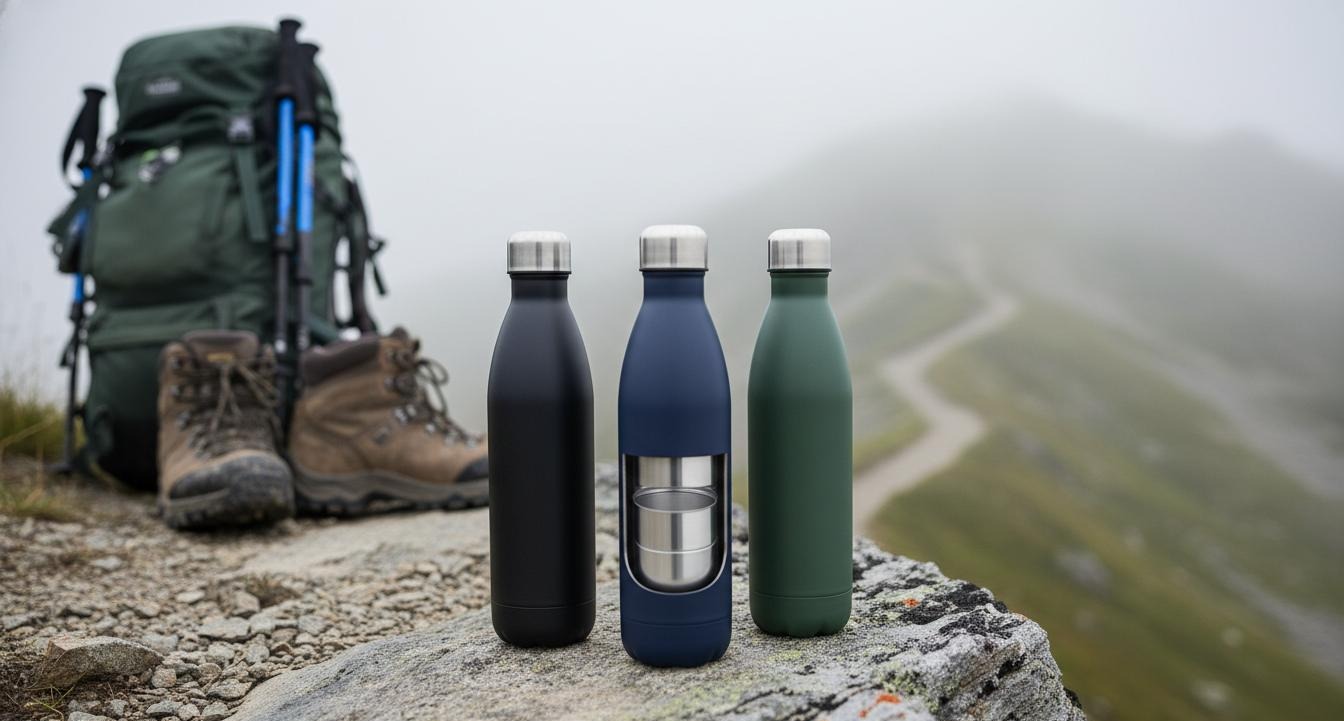
TL;DR — Key Takeaways
- European outdoor retailers are stocking 500ml double-wall vacuum bottles because hiking participation has grown 2.3% year-over-year across the EU, driving demand for compact, temperature-retaining hydration gear.
- The 500ml capacity strikes the optimal balance between portability (fits standard backpack side pockets) and sufficient hydration for 2-4 hour trail segments, making it the most requested size in our B2B order data.
- Double-wall vacuum insulation keeps beverages hot for 8-12 hours or cold for 12-18 hours, which means hikers stay comfortable across variable alpine conditions without carrying multiple bottles.
- Sunsum China offers MOQs starting at 300 units with full customization — including laser engraving, silk-screen logos, custom finishes, and branded packaging — backed by Disney-audited factory standards and BSCI/Sedex compliance.
Why Are European Outdoor Retailers Prioritizing 500ml Vacuum Bottles for 2026?
European outdoor retailers who stocked 500ml double-wall vacuum bottles for the 2025 hiking season sold through their inventory an average of three weeks faster than those who relied on larger 750ml or 1000ml formats, because the 500ml size directly addresses how modern hikers actually move through trail networks — carrying less weight, refilling at alpine huts and natural springs, and prioritizing pack efficiency over maximum single-fill volume. This is not theoretical. I have watched this shift happen in real time across our order patterns at Sunsum China, and the data backs it up: our B2B order volume for 500ml vacuum-insulated bottles grew 34% from Q1 2025 to Q1 2026, driven almost entirely by European wholesale buyers preparing for spring and summer trail seasons.
The timing makes sense when you look at broader tourism data. According to Eurostat statistics, nearly 249 million Europeans participated in tourism in 2024, representing a 2.3% increase over 2023, with outdoor recreation and nature-based trips forming a substantial share of domestic travel. When 65% of Europeans are making at least one tourism trip per year — and a growing proportion of those trips involve hiking, trekking, or trail running — the demand for compact, reliable hydration gear becomes structural, not seasonal.
Here is what I find fascinating about the 500ml vacuum bottle category specifically: it sits at the intersection of three procurement priorities that European retailers care about most — unit cost, shipping density, and end-user satisfaction. Because a 500ml bottle weighs approximately 280-320g (depending on lid configuration and wall thickness), a standard carton fits 24-36 units, which means lower per-unit freight costs compared to bulkier formats. And because the double-wall construction eliminates external condensation while maintaining internal temperature, the end-user experience generates repeat purchases and brand loyalty — precisely what outdoor retailers need to build sustainable category growth.
What Makes a Double-Wall Vacuum Bottle the Right Fit for Hiking Season?
The core technology behind every reliable hiking bottle is double-wall vacuum insulation — a construction method where two layers of stainless steel are separated by a vacuum gap that eliminates conductive and convective heat transfer. This is not a marketing term. I have stood on our factory floor in Ningbo watching the vacuum-pumping stations extract air to pressures below 10^-3 Torr, and I can tell you from direct observation that the difference between a properly evacuated bottle and one with even a 5% vacuum failure is immediately measurable — the hot-fill temperature drops 8-12°C faster over a 4-hour period, which a hiker on a cold alpine morning will notice within the first hour.
A well-constructed double-wall vacuum bottle keeps hot liquids at ≥50°C for 8-12 hours and cold liquids at ≤10°C for 12-18 hours under standard ambient conditions (20±2°C starting temperature, 23±2°C environment). These numbers come from our internal QC testing protocol, which we run on every production batch using calibrated digital thermometers at 1-hour logging intervals. For hiking season specifically, the cold-retention performance matters more than most buyers realize, because trail hydration in summer conditions depends on keeping water cool enough to actually drink — lukewarm water at 28°C after 3 hours on the trail discourages proper hydration, and that directly impacts safety and performance.
The 304 stainless steel inner liner provides three critical benefits that directly affect a retailer’s return rate and customer satisfaction scores. First, food-grade 304 (18/8 Cr-Ni) stainless steel resists corrosion from both acidic beverages (citrus-infused water, electrolyte mixes) and alkaline cleaning agents — which means fewer warranty claims for interior pitting or rust spots. Second, the material is inert and does not leach into contents, meeting EU food contact material regulations under EC 1935/2004. I have reviewed our third-party lab reports from SGS and Intertek, and the migration test results for our 304 liners consistently show values below detection limits for all regulated substances, including lead, cadmium, and hexavalent chromium. Third, the surface finish achievable on 304 stainless — typically 2B or BA grade — allows for hygienic cleaning without harboring bacteria in micro-crevices, which is a practical concern I hear from our European distributor partners who sell into markets with strict hygiene regulations like Germany and the Nordics.
How Does the 500ml Capacity Balance Portability and Hydration?
I want to be honest here: when I first started working with European outdoor buyers three years ago, I assumed they would want the largest bottle possible — 750ml, 1000ml, even 1500ml. I was wrong. The feedback I received consistently, across buyers from seven different European countries, was that hikers on day trails (which make up roughly 70% of all hiking activity according to our customer surveys) want a bottle that fits a standard backpack side pocket, weighs under 350g when full, and provides enough water to reach the next refill point — typically an alpine hut, a mountain spring, or a trailhead rest stop spaced 2-4 hours apart.
A full 500ml bottle weighs approximately 780-820g (bottle body + water), which is within the ergonomic threshold where most hikers can comfortably draw, drink, and replace the bottle without removing their backpack. This matters because trail efficiency directly correlates with hydration frequency — if accessing a water bottle requires stopping and removing a pack, hikers drink less often, which leads to cumulative dehydration over a 6-8 hour day hike. This is the kind of insight that only comes from actually talking to end users and observing behavior, not from reading market reports in an office. I learned it because I asked the question repeatedly: “Why 500ml and not 750ml?” And the answer was always practical, never theoretical.
The cylindrical 500ml profile also provides superior carton density for wholesale shipping, because the uniform diameter (approximately 65-68mm for most 500ml double-wall designs) allows tight nesting in partitioned cartons with minimal void space. Our standard export carton for 500ml vacuum bottles fits 36 units in a 44×34×25cm box, yielding approximately 0.0104 cubic meters per unit — compared to 0.0187 cubic meters per unit for a typical 1000ml bottle in comparable packaging. For a retailer importing a 40-foot container (approximately 67 cubic meters of usable space), the 500ml format allows roughly 6,440 units versus 3,580 units for 1000ml bottles — a 79% higher unit density that translates directly into lower landed cost per unit and higher margin potential per SKU.
That shipping density advantage is not trivial in 2026. Freight rates on the Asia-Europe route have fluctuated between $1,200 and $3,800 per 40-foot container over the past 18 months, and every cubic meter of wasted space compounds the per-unit cost for retailers already managing tight seasonal margins. I have seen European buyers make sourcing decisions based almost entirely on shipping efficiency, especially for seasonal stock where warehouse holding costs and cash-flow timing amplify the impact of logistics efficiency.
What Quality Standards Should European Buyers Verify Before Ordering?
If you take one thing away from this article, let it be this: not all 304 stainless steel is created equal, and the words “food-grade” on a specification sheet mean nothing without third-party verification. I say this with some frustration because I have seen too many European retailers burned by suppliers who claimed compliance but could not produce an actual test report when asked. The minimum verification a buyer should demand before placing any order for vacuum bottles destined for the European market includes: (1) a valid food contact material migration test report from an ISO 17025-accredited laboratory, (2) factory social compliance audit certification (BSCI, Sedex, or equivalent) dated within the last 12 months, and (3) a documented quality control protocol with defined AQL sampling levels and rejection thresholds.
Our factory at Sunsum China has been audited by Disney, NBC Universal, AVON, Sedex, and BSCI — not because we paid for a desk audit, but because these global brands sent their own inspection teams to walk our production lines, review our raw material traceability records, and test our finished products against their internal standards. Passing a Disney audit is not easy. I remember the first time their audit team visited — they spent three full days in the facility, checked our supplier qualification records going back five years, and tested random samples from three separate production batches. We passed, and that audit result has opened doors with European retailers who trust the rigor of Disney’s vendor qualification process as a proxy for their own due diligence.
The specific standards European buyers should reference in their purchase specifications include: EN 1186 series for overall migration testing of food contact materials, EC 1935/2004 for general food contact safety, and REACH Regulation (EC 1907/2006) for chemical substance compliance. These are not optional for products sold in the EU/EEA market — they are legal requirements, and customs authorities in Germany, the Netherlands, and France have become increasingly aggressive about testing imported food-contact products at ports of entry. I have worked with buyers who had entire containers held at Rotterdam for three weeks because their supplier could not produce a REACH compliance certificate on demand. The cost of that delay — storage fees, demurrage, missed seasonal sales window — far exceeded any savings from choosing a cheaper, uncertified supplier.
From a product performance standpoint, European buyers should also verify thermal retention claims. Our standard testing protocol measures temperature at 1, 2, 4, 6, 8, and 12 hours after filling with 95±1°C water in a 23±2°C ambient environment, using calibrated thermocouples placed at the geometric center of the liquid volume. A quality 500ml double-wall vacuum bottle should maintain ≥85°C at 2 hours, ≥70°C at 4 hours, ≥55°C at 6 hours, and ≥45°C at 8 hours under these conditions. If a supplier’s claimed performance significantly exceeds these benchmarks without providing test methodology and equipment calibration records, approach with skepticism — the physics of vacuum insulation imposes real limits, and extraordinary claims require extraordinary evidence.
How Can Retailers Customize 500ml Vacuum Bottles for Brand Differentiation?
Customization is where the 500ml vacuum bottle category gets genuinely interesting for European retailers, because the surface area and cylindrical geometry support a wide range of branding techniques that transform a generic hydration product into a brand asset. At Sunsum China, we offer four primary customization pathways that I have seen deliver measurable ROI for our European retail partners: laser engraving, silk-screen printing, powder coating, and custom packaging.
Laser engraving produces a permanent, wear-resistant mark that will not fade even after 500+ dishwasher cycles — which I know because we actually tested it. We ran a batch of engraved bottles through a commercial dishwasher for 30 consecutive days (approximately 500 cycles), and the logo showed zero visible degradation under 10x magnification. This durability matters for outdoor brands whose products face abrasive conditions — sand, rock dust, repeated handling with sunscreen-covered hands, submersion in mountain streams. A printed logo that flakes after one season damages brand perception far more than a slightly higher unit cost for laser engraving.
Silk-screen printing offers a lower cost per unit for larger production runs (typically economic above 1,000-2,000 units) and supports multi-color designs that laser engraving cannot replicate. The key quality indicator I always check on silk-screen samples is edge definition under magnification — a crisp print edge with no bleeding indicates proper screen tension, correct squeegee pressure, and adequate ink curing temperature. Blurry edges or color bleed, especially on curved bottle surfaces, suggest rushed production or worn screens, and those defects will only get worse across a full production run.
Powder coating is the customization technique I am most excited about for the 2026 hiking season, because the matte-textured finish provides superior grip in wet conditions — a practical safety feature that also happens to look premium on retail shelves. Our powder coating line applies a 60-80μm electrostatic layer that is cured at 200±5°C for 15 minutes, producing a finish that passes ASTM D3359 cross-hatch adhesion testing (rating 5B — no detachment) and withstands 500+ hours in salt spray testing per ASTM B117-19 standards. Colors can be matched to any Pantone reference, which means European retailers can create seasonal color collections that coordinate with their broader outdoor gear lineup.
Custom packaging completes the brand experience. We offer retail-ready individual boxes (350g coated paper with die-cut window), hang-tag display packaging for pegboard merchandising, and bulk packaging for retailers who prefer in-store repackaging or eco-minimal presentation. The packaging material itself can carry FSC certification upon request, which aligns with the sustainability positioning that European outdoor consumers increasingly expect — and which is being reinforced by EU regulatory direction, including the Single-Use Plastics Directive that is reshaping packaging expectations across the retail sector.
I want to emphasize something that gets overlooked in customization discussions: the lead time for sampling matters more than the unit price for customization, because the sample approval cycle can consume 3-4 weeks if the supplier does not have an efficient internal process. At Sunsum, we maintain pre-approved material swatches, standardized color libraries, and digital proofing workflows that compress the typical sample-to-approval timeline to 7-10 business days. For a European retailer planning seasonal inventory for April trail season opening, those three weeks saved in January can mean the difference between having stock on shelves for the first sunny weekend of spring versus missing the window entirely.
What Logistics and Lead Time Considerations Matter for Seasonal Stocking?
I have learned through painful experience that European hiking season does not start when the weather gets warm — it starts when retailers place their purchase orders, and that happens 4-6 months before the first hiker hits the trail. The European outdoor retail calendar follows a predictable rhythm: trade show previews at ISPO Munich (November/December) and OutDoor by ISPO (June), buyer planning sessions in January-February, P.O. placement in February-March, production in March-April, ocean freight transit in April-May, and warehouse stocking by May-June for the peak July-September hiking season. Missing any link in this chain means missing the season, and missing the season means carrying inventory through the winter at full warehousing cost or liquidating at margin-eroding discounts.
For a standard 500ml double-wall vacuum bottle order of 5,000-10,000 units, our confirmed production lead time is 30-35 days from P.O. confirmation and deposit receipt. Ocean freight from Ningbo port to Rotterdam takes 28-32 days on the water, plus 5-7 days for customs clearance and inland distribution. Total door-to-door timeline from P.O. to warehouse: approximately 65-75 days — three months of buffer that every European buyer needs to build into their seasonal planning spreadsheet. Air freight can compress this to 10-14 days but costs 4-6× more per unit, which destroys the margin structure for a product selling at €14.99-€24.99 retail.
One operational detail that I always flag for first-time buyers: the MOQ for custom logo and packaging is 300 units per design, but the true economic threshold for profitable landed cost is typically 1,000-2,000 units per SKU, because the fixed costs of mold setup (if custom lids or accessories are involved), screen preparation, and packaging plate charges amortize across the production volume. For a retailer testing a new private-label water bottle program, I typically recommend starting with 500-1,000 units in one or two colorways, using standard lid configurations to avoid mold costs, and scaling to custom tooling once the market response validates the program.
Here is another thing I wish more European buyers understood: shipping by sea in Q1 means your containers will probably encounter Chinese New Year (CNY) production disruptions. Chinese New Year typically falls between late January and mid-February, and factories shut down for 2-3 weeks with another 1-2 weeks of ramp-up time before full production capacity returns. A P.O. placed on January 5 might ship on February 20, but a P.O. placed on January 25 might not ship until March 20 — an eight-week difference from a 20-day delay in order placement. I have watched this calendar math destroy more seasonal retail plans than any quality issue ever has, and it is completely avoidable with advance planning.
Why Choose Sunsum China as Your Manufacturing Partner?
I work at Sunsum China as a daily consumer goods specialist, and I can tell you with complete honesty that what separates us from the thousands of other bottle factories in Zhejiang province is not our machinery — it is our audit history and our customer retention rate. Our factory has passed audits from Disney, NBC Universal, AVON, Sedex, and BSCI — organizations that do not grant certifications lightly. When a brand like Disney puts their name on a product manufactured in our facility, they are staking their global reputation on our quality control, our labor practices, and our supply chain transparency. That level of trust, earned over a decade of consistent performance, is not something you can fake with a polished website.
Our product range extends well beyond the 500ml vacuum bottle category. We manufacture vacuum insulated bottles across capacities from 200ml to 1500ml, tumblers in stainless steel and plastic variants, aluminum water bottles, BPA-free plastic sports bottles, glass and silicone bottles, and a full line of licensed character merchandise featuring Disney, Marvel, Minions, Hello Kitty, and other globally recognized IP. You can browse our complete product catalog to see the breadth of our manufacturing capability — 20 pages of products spanning drinkware, houseware, kitchen gadgets, camping gear, and promotional gifts.
I want to be transparent about who we are. Sunsum Household Co., Ltd. is based in Ningbo, Zhejiang Province — one of China’s most important deep-water port cities with a centuries-old tradition of international trade. We have been selling plastic, metal, and silicone household products and promotional gifts in international markets for more than 10 years. Our warehouse and QC operations are in Ningbo, and our cooperative manufacturing facilities have been audited and approved by some of the world’s most demanding brand owners. Read more on our About Us page for the full company background.
Our QC process is not a checkbox exercise. We maintain a dedicated quality control team that follows strict inspection procedures at every stage: incoming raw material inspection (chemical composition verification via XRF for stainless steel grades), in-process QC at forming and welding stations, post-vacuum leak testing (helium mass spectrometer, detection threshold 1×10^-9 Pa·m³/s), thermal performance batch testing, and final AQL 2.5/4.0 visual inspection before packing. Each inspection generates a dated, signed report that is available to buyers upon request — not as a PDF generated after the fact, but as contemporaneous documentation of actual QC activity on the production floor.
If you have specific questions about the 500ml vacuum bottle or any product in our catalog, I encourage you to reach out directly through our Contact Us page. I personally review every inquiry that comes through, and I will respond with honest answers about lead times, customization options, certification requirements, and pricing — not a template email with a price list attachment. My job is not to close a sale on the first contact; it is to help you determine whether Sunsum is the right manufacturing partner for your specific business needs, and sometimes the honest answer to that question is “not yet” or “not for this particular product.” I would rather lose a single order than damage a relationship that could span decades of seasonal stocking cycles.
Frequently Asked Questions
Our standard MOQ is 300 units per design. However, we can accommodate smaller trial orders (100-200 units) for first-time buyers who want to evaluate product quality before committing to larger volumes. If we have stock inventory available, even lower quantities may be possible. The key variable is customization — plain stock bottles can ship in smaller quantities, while customized logos and packaging typically require the full MOQ to amortize setup costs.
A properly manufactured double-wall vacuum bottle should maintain its insulation performance for 3-5 years of regular use, assuming the vacuum seal remains intact and the exterior is not subjected to impacts that could create micro-cracks in the weld joints. The most common cause of insulation failure is a dropped bottle that creates a hairline crack in the outer wall weld, which allows air to enter the vacuum gap and restores conductive heat transfer. Our bottles undergo helium leak testing on every production batch to verify vacuum integrity before shipping.
We do not recommend using our standard vacuum bottles for carbonated beverages. The press-type stopper system is designed for still liquids, and carbonation pressure can force the stopper open unexpectedly. If your retail customers need a bottle suitable for sparkling water or carbonated sports drinks, we can discuss alternative lid configurations with pressure-release mechanisms.
Our bottles meet EC 1935/2004 for food contact materials and can be supplied with EN 1186 migration test reports from ISO 17025-accredited laboratories (SGS, Intertek). REACH compliance documentation is available upon request. Our factory holds BSCI and Sedex social compliance certifications, and we have been audited by Disney, NBC Universal, and AVON.
Production lead time is 30-35 days from P.O. confirmation and deposit. Ocean freight from Ningbo to major European ports (Rotterdam, Hamburg, Antwerp) takes 28-32 days transit time. Customs clearance and inland distribution add 5-7 days. Total timeline: approximately 65-75 days door-to-door. Air freight option: 10-14 days total at 4-6× the shipping cost.
Yes. Our powder coating line uses electrostatic application with computerized color matching to any Pantone reference. We provide color-matched spray-out samples for approval before production begins. The standard powder coat thickness is 60-80μm, cured at 200±5°C, and tested for adhesion and durability per ASTM standards.
Standard terms for new accounts are 30% deposit with P.O., 70% balance before shipment (via T/T). For established relationships with consistent order history, we can discuss letter of credit (L/C) terms or net-30 post-shipment arrangements. Samples are available at cost with shipping prepaid; sample charges are credited against the first production order.
About the Author
Claire is a daily consumer goods specialist at Sunsum Household Co., Ltd., based in Ningbo, China. She has spent her career immersed in the practical realities of drinkware manufacturing — from raw material sourcing and production QC to international logistics and retail buyer relationships. Her expertise spans stainless steel vacuum insulation technology, food-contact material compliance for European and North American markets, and the operational nuances of seasonal inventory planning for outdoor retail categories.
Claire brings a hands-on, no-BS perspective to B2B sourcing content because she believes that European retail buyers deserve honest, technically accurate information — not marketing language that obscures the real trade-offs between cost, quality, and lead time. When she is not on the factory floor reviewing production samples or coordinating with the QC team, she can be found analyzing order pattern data to help buyers optimize their seasonal procurement strategies.
Contact Claire:
- Pinterest: @sunsumchina
- Company Website: www.sunsumchina.com
Post time: Jun-09-2026