
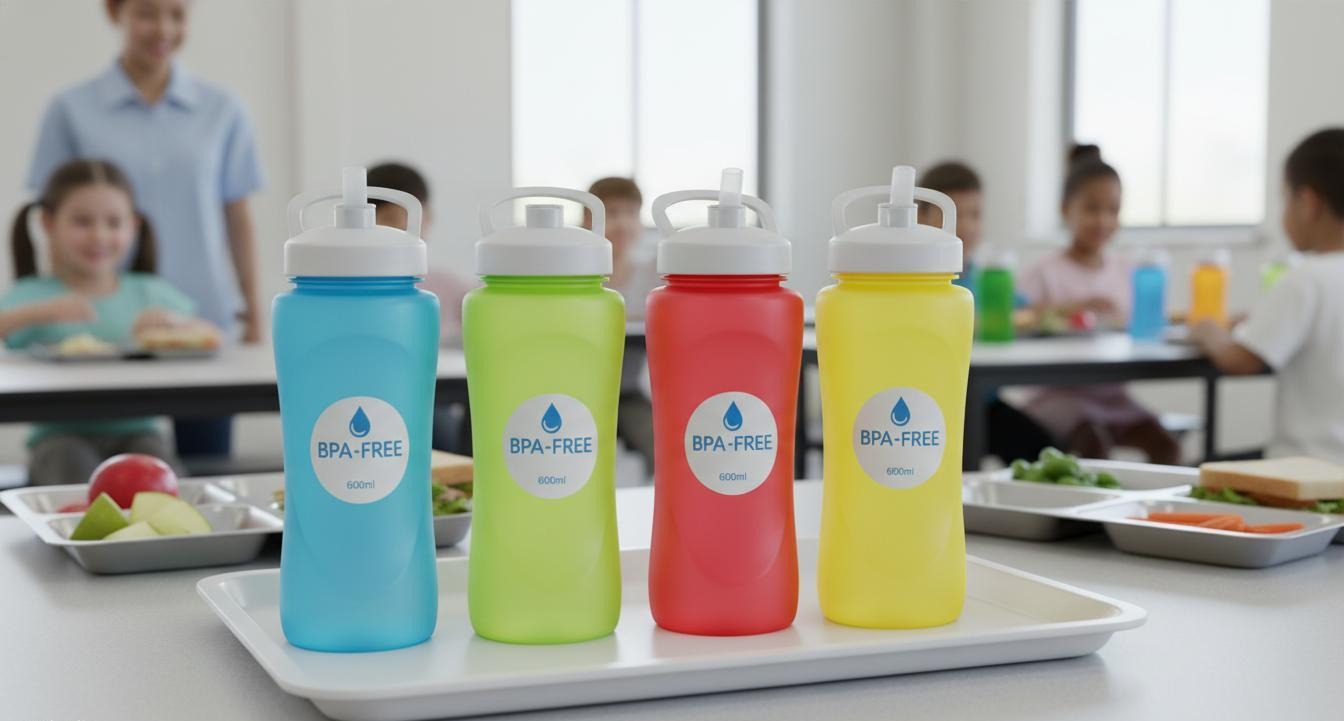
- US school districts are sourcing BPA-free 600ml pull-top plastic sports bottles for student lunch programs because the 600ml capacity matches typical K-12 daily hydration targets, the pull-top lid design satisfies child-safety requirements for younger students, and BPA-free materials comply with FDA food-contact regulations and USDA Child Nutrition Program guidelines.
- The three primary BPA-free materials used in school-approved plastic bottles are tritan copolyester (FDA-approved, crystal-clear), polypropylene (PP #5) (opaque, high impact resistance), and HDPE (#2) (opaque, excellent chemical resistance) — each suited to different budget and durability requirements.
- China OEM/ODM manufacturers like Sunsum China supply US school district orders withcustom logo printing, Pantone-matched colors, and FDA compliance documentation packages at per-unit pricing that becomes competitive at the 2,000-5,000+ unit tier.
- School district procurement cycles typically align with spring pre-ordering for fall semester rollout, with lead times of 45-60 days from artwork approval to port delivery on the US West Coast.
- California districts additionally require Proposition 65 compliance documentation — a California-specific requirement that bans reproductive toxicity chemicals in consumer products sold in the state — which adds a specific documentation layer to the FDA food-contact compliance package.
I have been working with US school nutrition program buyers for six years, and the single most consistent procurement trend I have seen accelerate since 2022 is the shift toward BPA-free plastic sports bottles as standard equipment in student lunch programs. The driver is not just consumer preference — it is regulatory. The US FDA has maintained a cautious stance on bisphenol-A in food-contact applications since the 2012 partial ban on BPA in baby bottles and sippy cups, and while the agency has not issued a blanket prohibition on BPA in all food-contact products, school district procurement officers have become increasingly risk-averse about stocking food-contact items that contain BPA for children. Add to that the USDA Child Nutrition Program guidelines that encourage healthy hydration behaviors in schools, and the result is a procurement profile that actively seeks BPA-free, durable, student-friendly water bottles at the 600ml capacity point.
The 600ml capacity figure is not arbitrary — it reflects the practical intersection of student hand size, school desk storage constraints, and targeted daily water intake. The Dietary Reference Intake for children aged 9-13 recommends approximately 2.1-2.3 liters of total water intake per day from all sources, of which roughly 500-700ml is a realistic school-day target from a personal water bottle. A 600ml bottle fits this requirement without being so large that it becomes unwieldy for a third-grader’s hand or so heavy when full that it tips a standard school desk tray. The pull-top lid design — a flip-cap or bite-valve mechanism — is preferred for K-8 students because it is easier for small hands than a screw-cap and reduces the risk of lost lids compared to loose caps.
The Regulatory Landscape: Why BPA-Free Is Now a Procurement Requirement, Not a Preference
For US school district procurement officers navigating food-contact product compliance, the regulatory framework is layered and involves at least three distinct regulatory domains. The primary layer is FDA food-contact regulation under 21 CFR parts 170-199, which governs the safety of materials that contact food. While the FDA has not issued a comprehensive ban on BPA in all food-contact polymers, the agency issued guidance in 2012-2013 that resulted in most major US food packaging manufacturers voluntarily phasing BPA out of products designed for infants and young children. The practical result is that many school district procurement specifications now explicitly require BPA-free certification even for general-use food-contact items, because the reputational risk of stocking a BPA-containing product that later generates negative press coverage exceeds the cost of specifying BPA-free alternatives upfront.
The second regulatory layer is Proposition 65, California’s Safe Drinking Water and Toxic Enforcement Act. This statute requires businesses to provide clear and reasonable warnings before exposing California residents to chemicals known to cause cancer, birth defects, or other reproductive harm. BPA is listed under Proposition 65, which means any school district in California — or any supplier selling to California school districts — must either ensure products contain no BPA or provide Prop 65 warnings on product labeling. For most school district procurement managers, providing Prop 65 warnings is operationally simpler than sourcing separate inventory lines for California versus non-California districts, so they specify BPA-free as a blanket requirement for all food-contact purchases.
The third layer involves USDA Child Nutrition Program requirements for federally reimbursement-eligible food service equipment. Schools participating in the National School Lunch Program, School Breakfast Program, or After School Snack Program must meet certain nutrition environment standards, and many state-level Child Nutrition agencies have adopted hydration-promotion guidelines that encourage schools to provide students with reusable water bottles. Some state agencies have gone further, explicitly recommending BPA-free materials for food-contact items in school nutrition environments.
Because BPA-free certification is now effectively a de facto procurement requirement rather than a preference in most US school district food service purchasing, the competitive landscape among suppliers has shifted to emphasize compliance documentation quality over price alone. A procurement officer evaluating two BPA-free bottle quotes will compare the completeness and credibility of the compliance documentation package — FDA food-contact letters, Prop 65 declarations, material safety data sheets — and will generally select the supplier with more comprehensive documentation even at a small premium. This is why Sunsum China invests in complete compliance documentation packages for every school nutrition program order, rather than providing generic statements of BPA-free composition.
Material Selection: Tritan vs. Polypropylene vs. HDPE for School Environments
When I consult with US school district buyers about BPA-free plastic bottle materials, the conversation almost always starts with tritan copolyester because it offers the clearest consumer-facing messaging: “BPA-free, crystal-clear, looks like glass but won’t break.” Tritan is a BPA-free polyester resin developed by Eastman Chemical that gained rapid adoption in the reusable water bottle market after BPA concerns accelerated. It is FDA food-contact compliant, dishwasher-safe up to 95°C, and optically clear — which matters for school nutrition programs where visual inspection of bottle contents (water versus sugary drinks) is a relevant monitoring point.
However, tritan is not always the right answer for school environments. The trade-off is impact resistance. Tritan’s high transparency comes with moderate impact resistance — sufficient for normal daily use but more prone to crack or craze under extreme impact (dropped on concrete from desk height, stepped on in a crowded cafeteria) compared to polypropylene. PP (#5 recyclable) absorbs impact more effectively, which makes it the preferred material for younger students (grades K-5) where bottles are more likely to experience rough handling. PP bottles are slightly translucent rather than crystal-clear, which is an acceptable trade-off for improved durability. Sunsum China offers both materials as standard options for school district orders, and we help procurement officers evaluate the right material choice based on the target student age range and usage environment.
HDPE (#2 recyclable) is the budget-material option for school district orders where cost-per-unit is the primary constraint. HDPE bottles are opaque, highly chemically resistant, and very durable under impact. The trade-off is reduced design flexibility — HDPE is not easily custom-shaped into the ergonomic forms that tritan and PP can accommodate — and a slightly more industrial aesthetic that some school districts find less appealing for student-facing products. For large district-wide rollout orders where the primary goal is functional hydration at minimum cost, HDPE is a legitimate option that delivers reliable service life in school environments.
Custom Logo Printing: What US School Districts Actually Need From Their Supplier
School district procurement for branded water bottles is as much a branding exercise as a nutrition program decision. Districts want bottles that carry their school mascot, district name, or the branding of a specific wellness initiative (the “Fuel Up to Play 60″ NFL-funded program is a common example). This means the customization requirements are specific and non-negotiable: Pantone-matched body colors that match the district’s official color palette, screen-printed or pad-printed logos that pass wash-resistance testing, and individual bagging or wrapping for hygiene distribution through school cafeterias.
For China OEM suppliers serving US school districts, the critical operational challenge is artwork management. School districts typically submit logos in a variety of formats — vector files from professional design programs, raster files from Word documents, email-compressed low-resolution versions — and the procurement officer who manages the order is often not a graphic designer. Sunsum China has developed a dedicated school district artwork workflow that includes logo file format conversion, color matching to Pantone standards, digital proof generation for district approval before production, and production sample approval runs for orders above 2,000 units. This workflow matters because the most common delay in school district bottle orders is artwork revision cycles — getting the proof approved, incorporating district feedback, and getting final sign-off within the procurement calendar.
Because school district procurement cycles are highly seasonal — with the majority of orders placed in Q1 for fall semester rollout and smaller orders in Q3 for spring programs — China suppliers must manage production capacity to honor committed lead times during peak ordering season. At Sunsum China, we reserve dedicated production lines for school nutrition program orders during the Q1 peak period, which allows us to maintain30-45 day production lead times even during our busiest season. For US procurement officers, this capacity reservation is a meaningful differentiator versus suppliers who promise short lead times but then miss them because they overcommitted during peak season.
Pricing and Procurement Economics: Making District-Wide Rollouts Financially Viable
The financial logic of BPA-free plastic sports bottle procurement for US school districts follows a predictable pattern. A district serving 5,000 students across 10 schools wants to issue each student one branded bottle per academic year. At retail pricing — say $8-12 per bottle through consumer channels — the total cost for a 5,000-unit order would be $40,000-60,000, which exceeds most school nutrition program supply budgets. The OEM wholesale channel changes the math dramatically: at the 5,000-unit tier with custom Pantone-matched printing, per-unit pricing typically lands in the $1.80-3.50 range depending on material selection (HDPE at the low end, tritan at the high end), bringing the total program cost to $9,000-17,500 for the same 5,000 bottles.
The unit economics improve further at higher volumes. At 10,000+ units, per-unit pricing for custom-printed tritan bottles can reach $1.50-2.00, making a district-wide rollout for a 10,000-student district cost $15,000-20,000 — comparable to or less than the cost of purchasing bottled water for the same student population over a single semester. Some districts fund these programs through wellness grants (including USDA Team Nutrition grants and state-level physical education funding), which can offset the procurement cost entirely.
For China suppliers, the MOQ (minimum order quantity) question is central to whether a school district can access OEM pricing. Many suppliers set MOQs at 5,000-10,000 units, which is too high for small rural districts serving 500-1,500 students. Sunsum China sets our standard OEM MOQ at 500 units for school district orders, with volume price breaks at 2,000 and 5,000 units that reach genuinely competitive pricing. This lower entry threshold allows smaller districts to access custom-printed BPA-free bottles without committing to volume they cannot absorb across their student population.
Sourcing Due Diligence: What US School District Buyers Should Verify With China Bottle Suppliers
I always advise school district procurement officers to conduct specific due diligence on their China bottle supplier before placing orders, because the BPA-free claim is only as credible as the documentation supporting it. The first thing to verify is whether the supplier provides FDA food-contact compliance letters specifically referencing the bottles being quoted, not generic “our products are BPA-free” statements. The compliance letter should reference the specific resin grade and manufacturer (e.g., Eastman Tritan TX1001 or equivalent) and should be backed by test reports from accredited laboratories — ideally labs with ILAC-MRA recognition that US regulatory bodies acknowledge.
The second due diligence item is Prop 65 testing. If the district includes any California schools, the supplier should provide Prop 65 compliance declarations backed by third-party testing. Prop 65 testing is more specific than general food-contact testing — it requires testing for a specific list of chemicals known to cause reproductive toxicity, and the testing threshold for BPA under Prop 65 is 0.1 micrograms per day, which is more stringent than general FDA food-contact thresholds. A supplier who cannot produce Prop 65 test reports on request is a supplier who has not properly characterized their compliance exposure for the California market.
The third due diligence item is production facility verification. For orders above 5,000 units, I recommend requesting the supplier provide documentation of their manufacturing facility — typically a facility audit report from a third-party inspection company like SGS, Bureau Veritas, or TUV. The audit should confirm the facility’s quality management system, material storage and segregation practices (to confirm BPA-free materials are not cross-contaminated with BPA-containing polymers during production), and production hygiene standards. This level of due diligence is standard for US school district food service procurement above a certain dollar threshold, and China suppliers who cannot provide facility documentation are essentially asking the buyer to accept unverified quality risk.
Frequently Asked Questions
Why are US school districts specifically ordering 600ml BPA-free plastic sports bottles with pull-top lids?
US school districts prefer 600ml BPA-free plastic sports bottles with pull-top lids because this configuration hits the practical sweet spot for student daily water intake (approximately 500-600ml per school day), satisfies child-safe lid requirements for K-8 students, and avoids bisphenol-A (BPA) compounds that US FDA regulations and school nutrition guidelines increasingly restrict in food-contact products used by children. The pull-top lid is also easier for younger students to operate independently compared to screw-cap designs, which reduces the instructional burden on cafeteria staff during meal service.
What BPA-free materials are available for school-approved plastic sports bottles?
The primary BPA-free alternatives for school food-contact plastic bottles are tritan copolyester (a BPA-free polyester with FDA food-contact approval, crystal-clear, dishwasher-safe to 95°C), polypropylene (PP, recycling code #5, superior impact resistance for younger students, slightly translucent), and high-density polyethylene (HDPE, recycling code #2, budget option with excellent chemical resistance and durability). Sunsum China supplies all three material types as standard options with complete FDA food-contact compliance documentation for each material grade.
What customization options do US school districts need for bulk plastic sports bottle orders?
US school district bulk orders typically require custom logo printing (school mascot, district name, or nutrition program branding), Pantone-matched body colors, individual bagging for hygiene distribution, and FDA-compliant material documentation packages. Sunsum China’s OEM/ODM service covers screen printing, pad printing, and wraparound full-color printing, with MOQs starting at 500 units and volume price breaks at 2,000 and 5,000 units that reach highly competitive per-unit pricing for district-wide programs.
What FDA compliance documentation do BPA-free plastic bottles need for US school food service procurement?
US school district procurement for food-contact products requires FDA food-contact material compliance letters (21 CFR 177-199 applicable), Proposition 65 compliance declarations for California districts, and often Child Nutrition Program documentation for federally funded lunch programs. Sunsum China provides complete FDA food-contact compliance documentation packages including material test reports from accredited US testing laboratories, Prop 65 compliance declarations, and material safety data sheets (MSDS) as standard deliverables for school district orders.
What is the typical lead time and pricing structure for US school district bulk bottle orders from China suppliers?
Typical lead times for custom-printed BPA-free plastic sports bottle orders from China range from 30-45 days for production plus 20-35 days for ocean freight to US West Coast ports (total50-80 days from artwork approval). Pricing structures for school district orders price-break at 500, 2,000, and 5,000 units, with per-unit costs of $2.50-4.00 (tritan), $1.80-3.00 (PP), and $1.20-2.00 (HDPE) at the 5,000+ unit tier. Most US school district orders are placed in Q1 for fall semester rollout, so procurement planning should begin in November-December of the prior year.
About Claire
Claire is a daily consumer goods specialist atSunsum China, a custom aluminum water bottle, insulated tumbler, and BPA-free plastic sports bottle manufacturer with OEM/ODM expertise serving global brands. She specializes in school nutrition program procurement, FDA compliance documentation for US food-contact products, and BPA-free material sourcing for consumer goods buyers. Sunsum China exports to Europe, America, Australia, and global markets. Connect: Pinterest
Post time: Jun-08-2026